Understanding Your HVAC Equipment's Expected Lifespan
When you invest in an HVAC system for your Maricopa County home, understanding how long that equipment will last is critical to making smart decisions about repairs and replacements. Most residential air conditioning units in the Phoenix area operate for 15 to 20 years before reaching the end of their useful life, while furnaces typically last 15 to 25 years with proper maintenance. However, the desert climate here in Maricopa County—with extreme heat, dust storms, and hard water conditions—can accelerate wear on components. On Time HVAC Phoenix has served Maricopa County residents for over a decade, and we've seen firsthand how equipment ages differently depending on installation quality, maintenance habits, and local environmental factors. Your system's lifespan isn't just about calendar years; it's about how well you've cared for it and how efficiently it's performing today.
🔊 Hear On Time HVAC Phoenix's Expert Guide on HVAC Leak DetectionThe 50% Rule: Your Guide to Repair vs Replace Decisions
One of the most practical frameworks for deciding whether to repair or replace your HVAC system is what professionals call the 50% rule. Here's how it works: multiply the age of your equipment by the cost of the repair. If that number exceeds 50% of the cost to replace the entire system, replacement becomes the smarter financial choice. For example, if your system is 12 years old and a compressor repair costs $2,500, and a full replacement would run $7,000, then 12 multiplied by $7,000 equals $84,000—which far exceeds the repair cost, making repair reasonable. On Time HVAC Phoenix provides transparent, upfront pricing on every job, so you can apply this rule confidently when making your decision. We explain everything clearly so you understand exactly what you're investing in.
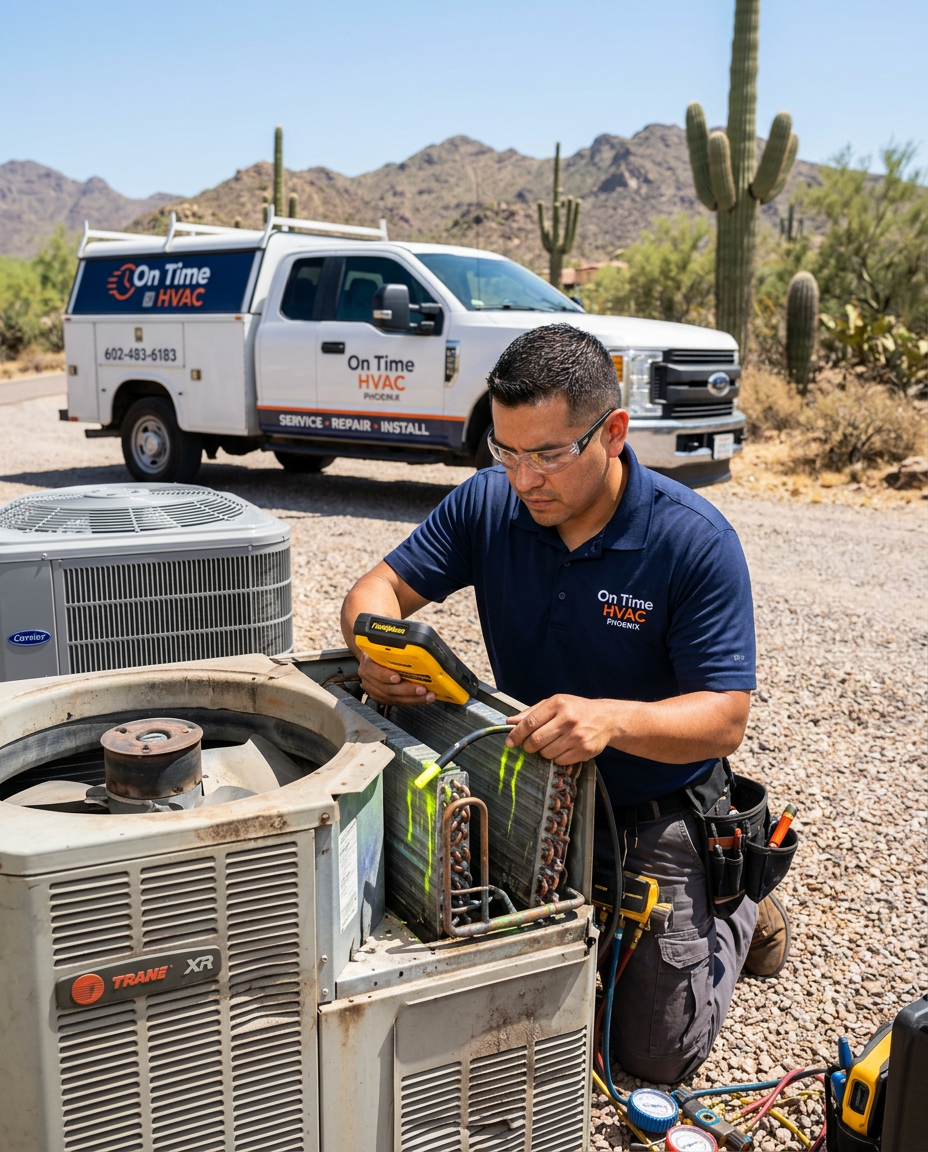 HVAC Leak Detection services from 26 E Pima St, Phoenix, AZ specialists
 Component Lifespan Varies Across Your System
Not every part of your HVAC system ages at the same rate. Compressors, which are the heart of your air conditioning unit, typically last 10 to 15 years but can fail sooner if the system hasn't been properly maintained or if refrigerant levels drop. Capacitors usually last 5 to 10 years and show clear warning signs when they're failing—humming sounds or the system refusing to start. Blower motors generally last 10 to 20 years depending on usage and how frequently you run your system during Phoenix's long cooling season. If you need to replace a blower motor in your furnace, expect to invest between $300 and $900 depending on the motor type and your specific system model. Evaporator coils can last 10 to 15 years, while condenser coils in your outdoor unit typically survive 10 to 20 years but degrade faster in Maricopa County's dusty environment. On Time HVAC Phoenix provides HVAC Leak Detection in Maricopa County to identify component failures before they compromise your entire system.
How the Desert Climate Impacts Equipment Longevity
Maricopa County is located in Phoenix, AZ and presents unique challenges for HVAC systems that differ from other regions. Temperatures regularly exceed 115°F during summer months, which means your air conditioning runs nearly nine months per year—longer than almost anywhere else in the nation. This extended cooling season puts constant stress on compressors and motors. The monsoon season from July through September brings dust storms that clog filters and outdoor condenser coils within days, forcing your system to work harder and overheat. Hard water with mineral content accumulates in pipes and equipment, restricting flow and reducing efficiency. UV radiation degrades outdoor equipment faster than in humid climates. Dorrance DOME sits near Maricopa County and experiences the same intense solar exposure your HVAC equipment faces. These factors mean that while a system might last 18 years in a moderate climate, your Maricopa County equipment might show serious degradation by year 12 or 13.
Efficiency Degradation: When Aging Systems Cost Too Much to Run
As HVAC systems age, they lose cooling capacity and efficiency even if they're still technically functional. A system that achieved a 16 SEER rating when new might operate at 12 SEER or lower by year 15, meaning it's using significantly more electricity to produce the same cooling effect. In Maricopa County, where summer cooling bills can easily exceed $300 monthly, this efficiency loss translates to real money leaving your wallet. Modern systems must meet SEER2 14.3 minimum standards for our Southwest region—a significant jump from older efficiency levels. If your system is over 12 years old and your cooling bills have crept up consistently, inefficiency is likely the culprit. Replacing with a modern, efficient unit often pays for itself through energy savings within five to seven years, especially in our desert climate where cooling demands are intense. On Time HVAC Phoenix provides professional guidance on whether your aging system's operating costs justify replacement investment.
Warning Signs Your System Is Nearing End of Life
Certain warning signs indicate that your HVAC system is approaching the end of its reliable service life. If your system requires repairs more than once per year, or if a single repair exceeds 50% of replacement cost, replacement becomes increasingly attractive. Refrigerant leaks signal serious problems—R-22 was phased out completely by January 2020 and is now expensive and scarce, making older systems costly to maintain. HVAC Leak Detection helps prevent compressor failure and refrigerant loss that can strand you without cooling during peak summer heat. Strange noises like grinding, squealing, or persistent rattling often indicate bearing failure or motor problems that typically warrant replacement rather than repair. If you're noticing reduced airflow despite clean filters, your evaporator coil might be degraded. Visible corrosion on your outdoor condenser unit suggests structural compromise. Maricopa County homeowners frequently need HVAC Leak Detection to determine whether continued repair spending makes financial sense. On average, if your system is past age 12 and exhibiting multiple warning signs, replacement planning should begin soon.
Making the Financial Case for Replacement vs Repair
Beyond the 50% rule, several financial considerations favor replacement when your system is aging. New systems qualify for federal tax credits and rebates that can offset 10-30% of installation costs—savings that disappear when you choose repair. Variable-speed compressors and smart thermostat integration in modern units reduce energy consumption by 15-25% compared to older fixed-speed equipment. If your current system requires $2,000 in repairs and you're facing another $1,500 repair possibility within the next two years, total spending might reach $3,500—dangerously close to partial replacement costs. Newer systems come with thorough manufacturer warranties, while aging equipment often has no warranty coverage. On Time HVAC Phoenix provides honest, reliable assessments that help you understand the true financial picture. We're backed by 5-star Google reviews from Maricopa County homeowners who trusted our professional recommendations.
Planning Your Replacement Timeline with Confidence
Smart homeowners don't wait for complete system failure to plan replacement—they act when their system reaches age 10 to 12 and begin investigating upgrade options. This approach gives you time to research equipment, compare brands like Trane, Carrier, and Lennox, and budget for the investment. https://edgaragly231.huicopper.com/hvac-leak-detection-in-encanto-village-comparing-repair-vs-replacement-approaches Scheduling your replacement during shoulder season—March through April before peak cooling demand hits—gives better availability and potentially faster installation. On Time HVAC Phoenix serves Maricopa County residents with planning assistance and professional installation that gets your new system running efficiently immediately. When you're ready to discuss whether repair or replacement makes sense for your specific situation, contact us at 602-483-6183 or visit https://ontimehvacphoenix.com/ to schedule your evaluation. Understanding your equipment's age, condition, and the true cost of continued repairs empowers you to make decisions that protect your investment and keep your Maricopa County home comfortable for years ahead.
Call 602-483-6183 for HVAC Leak Detection in Phoenix, AZ "@context": "https://schema.org", "@type": "LocalBusiness", "name": "On Time HVAC Phoenix", "telephone": "602-483-6183", "address": "@type": "PostalAddress", "streetAddress": "26 E Pima St", "addressLocality": "Phoenix", "addressRegion": "AZ", "postalCode": "85003" , "url": "https://ontimehvacphoenix.com/", "areaServed": "Maricopa County", "description": "Professional HVAC Leak Detection serving Maricopa County in Phoenix, AZ.", "sameAs": ["https://www.facebook.com/OnTimeHVACPho/","https://www.instagram.com/ontimehvacpho/","https://www.youtube.com/@OnTimeHVACPho","https://www.linkedin.com/company/ontimehvacpho/","https://x.com/OnTimeHVACPho","https://www.tiktok.com/@ontimehvacpho","https://www.pinterest.com/OnTimeHVACPho/"], "image": "@type": "ImageObject", "url": "https://lh3.googleusercontent.com/d/1AMCd4neRMhYCza-oLiD2DZNlaxoQmKmP", "name": "HVAC System Lifespan in Maricopa County: Repair vs Replace Decision Guide Service Image", "description": "Image for: How much does it cost to replace a blower motor in a furnace?", "encodingFormat": "image/png" , "audio": "@type": "AudioObject", "contentUrl": "https://drive.google.com/file/d/1_yqwMyZlqM8G50zWSNFbniqKUNGY1KGa/view", "name": "HVAC System Lifespan in Maricopa County: Repair vs Replace Decision Guide Expert Audio", "description": "Audio answer to: How much does it cost to replace a blower motor in a furnace?", "encodingFormat": "audio/wav"